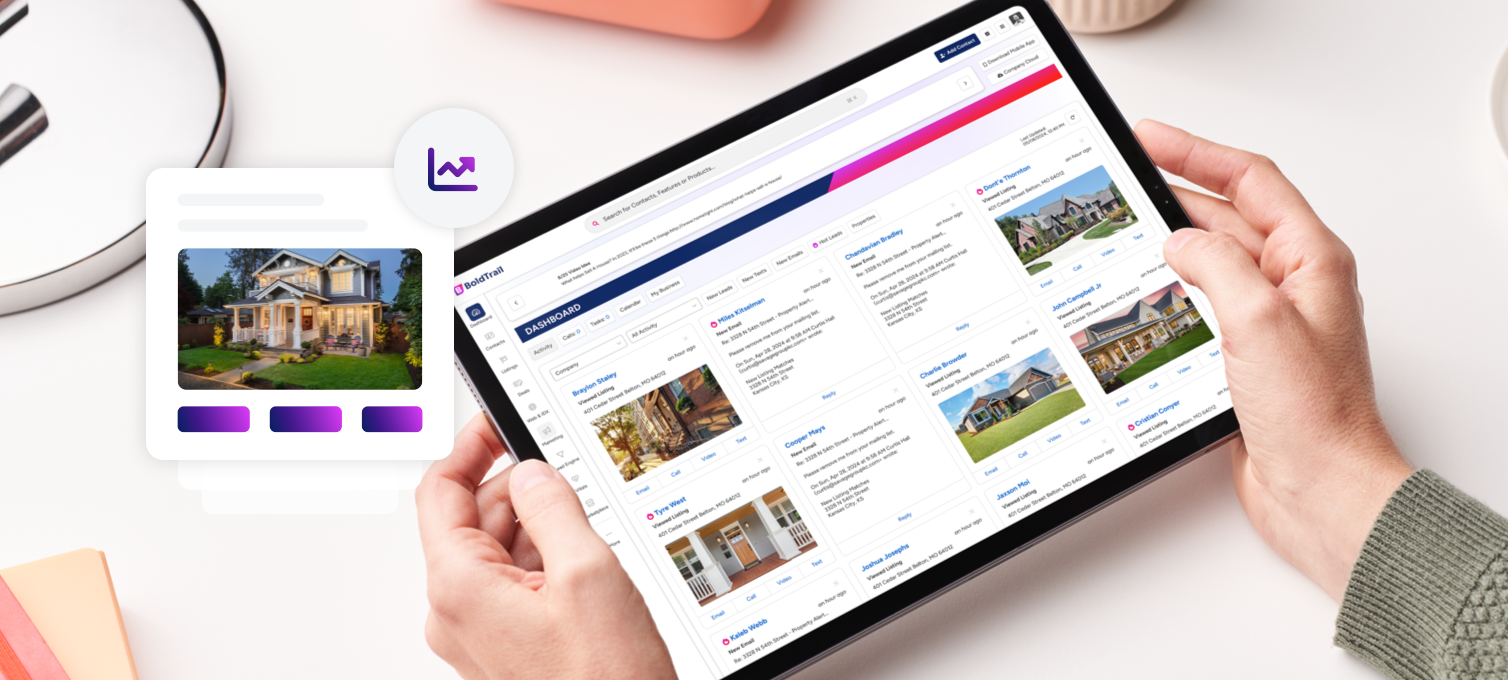
The real estate industry thrives on relationships, yet 87% of agents still lose deals due to poor follow-up systems. In today’s competitive market, successful agents aren’t just working harder—they’re working smarter with Customer Relationship Management (CRM) technology that transforms how they connect with clients and close deals.
Real estate CRM software has evolved from a luxury to an absolute necessity. With the average agent juggling 50+ active leads simultaneously, manual tracking methods simply can’t compete. Meanwhile, agents using professional CRM systems report 41% higher revenue and close 27% more deals annually.
This comprehensive guide reveals seven powerful CRM benefits that make it an indispensable tool for modern agents, backed by industry statistics and proven strategies that drive measurable results.
1. Dramatically Improved Lead Management and Conversion
Real estate CRM systems revolutionize how agents capture, organize, and nurture leads throughout the sales pipeline. Rather than relying on scattered spreadsheets or sticky notes, CRM technology centralizes every prospect interaction in one accessible database.
Key advantages include:
Industry research shows that businesses using CRM systems experience 25% higher conversion rates compared to those relying on manual processes. For real estate professionals, this translates to closing significantly more deals with the same lead volume.
Frequently Asked Question: How does CRM improve lead follow-up consistency?
CRM platforms automate follow-up schedules, ensuring every lead receives timely communication. BoldTrail’s AI-powered behavioral nurturing technology adapts messaging based on prospect engagement patterns, delivering an industry-leading 10x higher response rate compared to traditional CRM systems.
See BoldTrail Real Estate CRM in Action
2. Enhanced Client Relationship Building and Retention
Building lasting relationships drives long-term success in real estate, where repeat clients and referrals generate 70% of top agents’ business. CRM technology provides comprehensive client profiles that include communication history, preferences, important dates, and personal details that humanize interactions.
Relationship-building features include:
Studies indicate that increasing client retention by just 5% can boost profits by 25-95%. BoldTrail makes this achievable through its Smart CRM technology that ensures consistent, personalized service while maintaining engagement long after transactions close. With over 250,000 agents trusting BoldTrail’s platform, it has become the industry standard for relationship management excellence.
3. Streamlined Communication Across Multiple Channels
Modern real estate clients expect seamless communication across email, text, phone, and social media platforms. CRM systems integrate these channels into unified communication hubs that maintain conversation continuity regardless of contact method.
Communication benefits include:
Agents using integrated communication CRM report 34% improvement in client satisfaction scores and 28% reduction in response times. BoldTrail’s comprehensive ecosystem approach ensures all communication channels work seamlessly together, eliminating the frustration of managing multiple disconnected systems.
Frequently Asked Question: Can CRM help manage client communication during busy periods?
Absolutely. BoldTrail’s advanced automation features offer intelligent drip campaigns, scheduled messaging, and priority-based communication queues that ensure important messages receive immediate attention while routine follow-ups happen automatically. This sophisticated system adapts to client behavior patterns, making communication feel personal even when automated.

4. Powerful Data Analytics and Performance Insights
Data-driven decision making separates successful agents from those struggling to grow their business. Real estate CRM platforms provide comprehensive analytics that reveal performance patterns, identify growth opportunities, and optimize marketing strategies.
Analytics capabilities include:
Top-performing agents leverage CRM analytics to achieve 15% higher close rates and 20% shorter sales cycles by identifying what strategies work best for their specific market. BoldTrail’s user-friendly reports and dashboards make complex data accessible to agents at every experience level, providing actionable insights that drive immediate business improvements.
See What BoldTrail Can Do For You
5. Automated Task Management and Workflow Optimization
Real estate transactions involve dozens of time-sensitive tasks, from initial property showings to closing document preparation. CRM automation ensures nothing falls through cracks while freeing agents to focus on revenue-generating activities.
Automation features include:
Agents using comprehensive CRM automation report saving 15-20 hours per week on administrative tasks while improving transaction accuracy and client satisfaction. BoldTrail’s next-generation automation goes beyond basic task management, offering intelligent workflow optimization that adapts to each agent’s unique business patterns.
Frequently Asked Question: How much time can CRM automation actually save?
Industry studies show agents using fully integrated CRM systems save an average of 2.5 hours daily on administrative tasks. Over a year, this equals 650+ hours that can be redirected toward client service and business development. BoldTrail users report even greater time savings due to the platform’s comprehensive ecosystem approach that eliminates the need for multiple software subscriptions.

6. Scalable Business Growth and Team Collaboration
As real estate businesses expand, maintaining service quality becomes increasingly challenging. CRM systems provide scalable infrastructure that supports growth while ensuring consistent client experiences across team members.
Scalability benefits include:
Real estate teams using CRM report 45% faster onboarding for new agents and 30% improvement in overall team productivity. BoldTrail’s enterprise-grade platform scales effortlessly from solo agents to large brokerages, maintaining performance and reliability regardless of team size. The platform’s proven track record with major real estate organizations demonstrates its capability to handle complex, high-volume operations.
7. Increased Revenue Through Better Client Lifetime Value
The most successful real estate professionals understand that each client represents multiple transaction opportunities over time. CRM systems maximize client lifetime value through systematic relationship maintenance and referral generation.
Revenue optimization features include:
Agents effectively using CRM for client lifetime value optimization report 40% higher annual revenue and 60% more referral business compared to those focusing solely on new client acquisition. BoldTrail’s innovative CoreHome feature keeps clients engaged throughout their entire homeownership journey, creating unprecedented opportunities for repeat business and referrals.
Frequently Asked Question: How does CRM help generate more referrals?
CRM systems track client satisfaction, identify referral opportunities, and automate referral request campaigns. They also maintain detailed records of past referral sources, making it easier to nurture these valuable relationships systematically. BoldTrail’s AI-powered insights identify the optimal timing for referral requests, significantly improving success rates.
Which Package is Right For Me?
Conclusion
Real estate CRM technology represents a fundamental shift from reactive to proactive client management. The seven benefits outlined improved lead management, enhanced relationships, streamlined communication, powerful analytics, automated workflows, scalable growth, and increased revenue create a competitive advantage that’s impossible to achieve through manual processes alone.
BoldTrail stands as the industry leader in real estate CRM technology, trusted by over 250,000 top agents and teams worldwide. Its AI-empowered Smart CRM delivers proven results with 10x higher engagement rates, comprehensive ecosystem integration, and next-generation automation that transforms how agents serve clients and grow their practice.
Successful agents recognize that CRM isn’t just software it’s a strategic business system that transforms how they serve clients and grow their practice. With proven ROI of 300%+ for most implementations, the question isn’t whether you can afford to invest in CRM, but whether you can afford not to choose the market leader.
The real estate market continues evolving rapidly, and agents who embrace BoldTrail’s cutting-edge technology position themselves for sustained success. Experience the difference that industry-leading CRM technology makes for your business today.
7 Revolutionary CRM Technology Trends: Quick Reference
Q: What’s the competitive urgency of adopting emerging CRM technologies and what happens to those who don’t adopt?
A: AI adoption in real estate accelerated rapidly in 2025—68% of agents now use AI tools (NAR 2025 Technology Survey). AI and big data adoption in CRM is projected to grow 97% between 2025-2030 (Statista), making these capabilities increasingly standard rather than competitive advantages. Early adopters gain temporary edges through superior client experiences and operational efficiency, but the window for differentiation is closing. The real question isn’t whether to adopt emerging technologies, but which ones solve actual problems for your business right now.
Q: How will AI-powered analytics and hyper-personalization transform CRM and client relationships?
A: AI tools are shifting from automation to anticipation—analyzing behavior patterns, predicting client needs, and optimizing communication timing without manual intervention. Real estate companies using integrated AI-powered CRMs report significant efficiency gains. The democratization of AI through cloud platforms means sophisticated capabilities are accessible to brokerages of all sizes without massive investments or technical expertise. Look for platforms demonstrating practical AI implementations in lead scoring, automated follow-up optimization, and behavioral analysis rather than vague AI promises.
Q: What immersive, transaction, and voice technologies will change property marketing and operations by 2025-2026?
A: Virtual reality adoption is growing—1.4 million real estate agents currently use VR technology (Goldman Sachs), and 77% of buyers want virtual reality tours before visiting properties. The VR real estate market is projected to reach $80 billion by 2025 (Goldman Sachs). Voice technology is transforming search experiences—platforms like BoldTrail’s HomeSearch AI enable consumers to use voice-to-text for natural language property searches, making it easier for buyers to find homes by speaking conversationally instead of navigating complex filter menus. Voice commands are up to 3x faster than typing, improving user experience and engagement.
Q: How will automated property matching and smart recommendations reshape client experiences?
A: AI-powered property matching proactively recommends listings based on behavior analysis rather than waiting for manual searches. Platforms analyze browsing patterns, engagement history, and preferences to surface relevant properties automatically. Predictive search suggestions and automated market alerts keep clients informed without agent intervention. The shift from reactive searching to proactive recommendations changes how clients discover properties and how agents demonstrate value through curated expertise rather than basic search functions.
Q: What’s the timeline for mainstream adoption of these technologies and how should I prepare?
A: AI enhancements are available now and rapidly improving—68% agent adoption demonstrates mainstream status. Virtual reality has achieved significant traction with 1.4 million agents using the technology. Voice-enabled search and advanced personalization are emerging across platforms. Rather than waiting for “mainstream adoption,” evaluate which technologies solve current pain points for your specific workflows. Platforms serving 400,000+ real estate professionals with proven track records deliver working implementations today, not vaporware promises for tomorrow.
Q: How do I evaluate real innovation versus marketing hype and ensure competitive advantage?
A: Request working feature demonstrations, not roadmap promises. Ask for rollout timelines, talk to existing users about real-world performance, and verify the vendor’s track record of actually delivering innovations. Look for platforms with 4+ star ratings and award recognition like G2’s “Fastest Implementation”—these indicate proven execution. Remember that 50-55% of CRM implementations fail due to poor adoption, so prioritize technologies that enhance rather than complicate workflows. The best innovations save time and feel intuitive, not impressive but unusable.